Range Repair
Your Los Feliz Oven Isn't Broken, Your 1928 Service Panel Is: Measuring Voltage Under Load Before Replacing a Viking
When a Viking oven heats slowly, throws a low-voltage code or trips the main partway through a self-clean, measure the voltage at the terminal block while it is pulling before condemning the control board — old services and old branch wiring produce exactly those symptoms.
Sam Achterberg
- Role
- Service technician — electrical and intermittent faults
- In the trade
- 15 years
Measures at the appliance rather than at the panel. Voltage that looks fine at the breaker and sags at the terminal explains a whole class of intermittent faults that otherwise get answered with a new board.
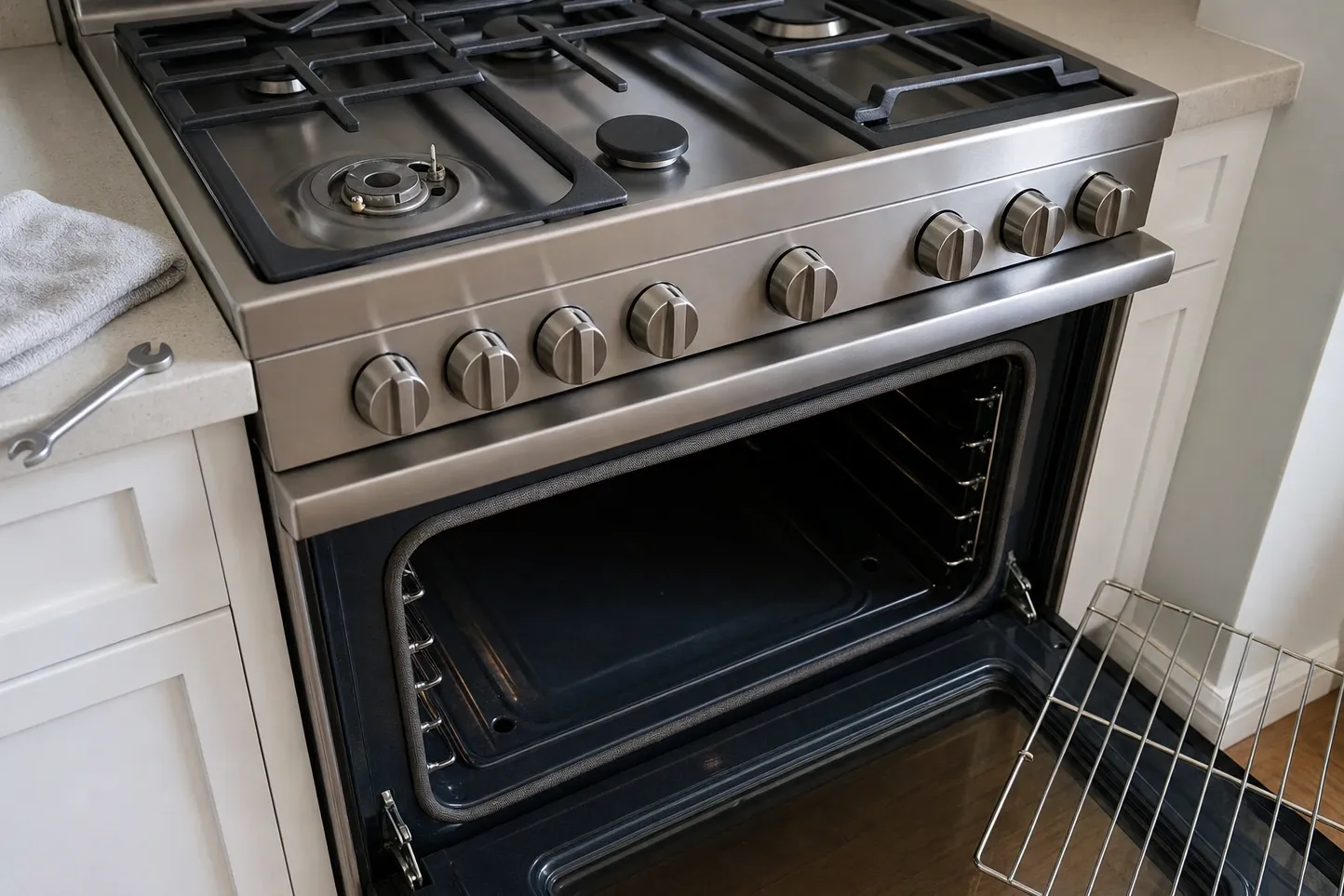
There is one diagnostic habit that saves people a control board more often than any other, and it is simply this: put a meter on the terminal block while the appliance is actually pulling current, and read it before deciding anything. In the older housing above Sunset, that reading is more interesting than most people expect it to be.
The question worth asking first
When a Viking oven heats slowly, faults on a low-voltage code, or trips the main partway through a self-clean, the question is not which component failed. It is whether the appliance is failing or the supply behind it is sagging. Those two produce an identical complaint, cost wildly different amounts, and cannot be told apart from the front panel.
Control boards are among the most replaced parts in this trade and among the most wrongly replaced. A board that browns out under load reports nonsense — spurious sensor readings, phantom codes, relays that chatter — and a new one, fitted into the same supply, will do the same thing within weeks. The board is a symptom reader. If the supply is the fault, the board is telling the truth.
What shortens an appliance life here specifically
Silver Lake and Los Feliz hold some of the oldest single-family stock in the city. No statistic about a neighbourhood is going to tell you anything useful about your own street, but the era those hillsides were built in is real enough, and it is the era of knob-and-tube branch circuits and modest main services.
That is as far as the neighbourhood claim goes honestly. What matters is what shows up at the panel of the house we are standing in. Houses from that period were built with far less service capacity than a modern kitchen assumes, and how much less is a question for the panel rather than for the build date. A self-clean cycle is the heaviest sustained electrical load a domestic kitchen ever runs, and where the service is shared with air conditioning through a Studio City or Sherman Oaks afternoon, the two loads collide at exactly the wrong moment.
Old branch wiring adds a second problem that has nothing to do with capacity. Knob-and-tube carries no equipment ground, so there is nothing to bond the appliance chassis to, and there is rarely spare capacity to run the dedicated 240-volt circuit a dual-fuel range or a double wall oven wants without a service upgrade and LADWP coordination.
Reading the machine you already own
You can do most of the useful narrowing before anyone arrives, and it takes no tools.
Note when the fault happens. At preheat only, mid-bake, or exclusively during self-clean? Self-clean-only is the strongest single indicator that the supply, not the appliance, is the constraint, because nothing else in the house draws that hard for that long. Note what else was running — air conditioning, a pool pump, a dryer. Note whether a cold start with everything else switched off behaves differently. And note whether the main breaker trips or only the appliance faults; those are different findings.
Then the part that needs instruments. We read both legs at the terminal block at rest and again under load, and the size of the drop between those two readings is the finding — not a number off the display. We look at the terminal block itself for heat discoloration and loose lugs, because a bad connection produces voltage drop that no panel upgrade will fix. We check whether the breaker handle is warm. Element resistance and sensor values are taken in the same pass, so the board is evaluated with everything else already known.
Repair, or start again
If the appliance is sound and the supply is the constraint, the honest answer is that the repair is not ours. It belongs to an electrician, and in a house with knob-and-tube it may mean a service upgrade with utility coordination rather than a quick circuit addition. Saying that plainly is the entire value of the visit, because the alternative is buying a board twice.
Where the fault genuinely is in the appliance, it lands in one of the repair bands on the rate plate — a control board or touch panel is one of them, an oven thermostat or heating element another. The plate is printed in full on the oven repair page, and whichever band applies, your figure is worked out at the visit and agreed with you before anything further is opened up.
The narrow galley kitchens of Silver Lake and the Spanish Colonial layouts under Griffith Park add one more consideration: pulling a wide professional range forward far enough to reach its terminal block is itself a two-person job on a tiled floor, so it is worth doing once, thoroughly, rather than twice.
What a diagnosis gives you
That diagnostic costs $89, and it buys a decision you can act on: whether the fault sits in the appliance or behind it, what the measured voltage does under load, which components tested good, and — if the answer is electrical — precisely what to hand to an electrician so they are not guessing either.
When you book, say whether the fault appears only during self-clean, what else runs at the same time, and whether the panel has ever been upgraded. Mention on (213) 320-7007 what you have already tried; it shortens the visit.
Asked after this one
- My oven trips the main breaker during self-clean but works fine otherwise. Is the oven broken?
- Often not. Self-clean is the longest, heaviest sustained load a kitchen ever puts on a service, so it is the cycle that exposes a supply operating near its limit rather than a component that has failed. The check is voltage at the terminal block under load, plus what else was running. If the appliance tests good, the work belongs to an electrician, and we will say so.
- Do I need to rewire a 1920s Los Feliz house to use a professional range?
- Not necessarily rewire, but the range does need its own dedicated 240-volt circuit with a proper equipment ground, and knob-and-tube branch wiring provides no ground to bond to. Whether the existing service has spare capacity is a panel question, answered by measurement, not by the house's age. Some homes need only a new circuit; others need a service upgrade with utility coordination first.
- How can I tell a failing control board from a voltage problem?
- From the front panel you cannot, and that is the trap. A board browning out under load throws the same codes as a board that has actually failed. The distinguishing test is a meter on both legs at the terminal block at rest and under load: a board fault holds steady voltage, a supply fault sags when the elements pull. A board is the dearest part on the rate plate, so the test is worth doing first.