Range Repair
Viking burner clicks and clicks but will not light
A Viking burner that sparks endlessly without catching is almost never a gas fault. Here is what the clicking is, the three things that stop it lighting, and what you can check in ten minutes before anyone comes out.
Hollis Yamada
- Role
- Service technician — refrigeration and cooking
- In the trade
- 21 years
Splits a call into the sealed system and everything else before opening anything, then works whichever half the symptom really belongs to. The two share a cabinet and almost nothing else.
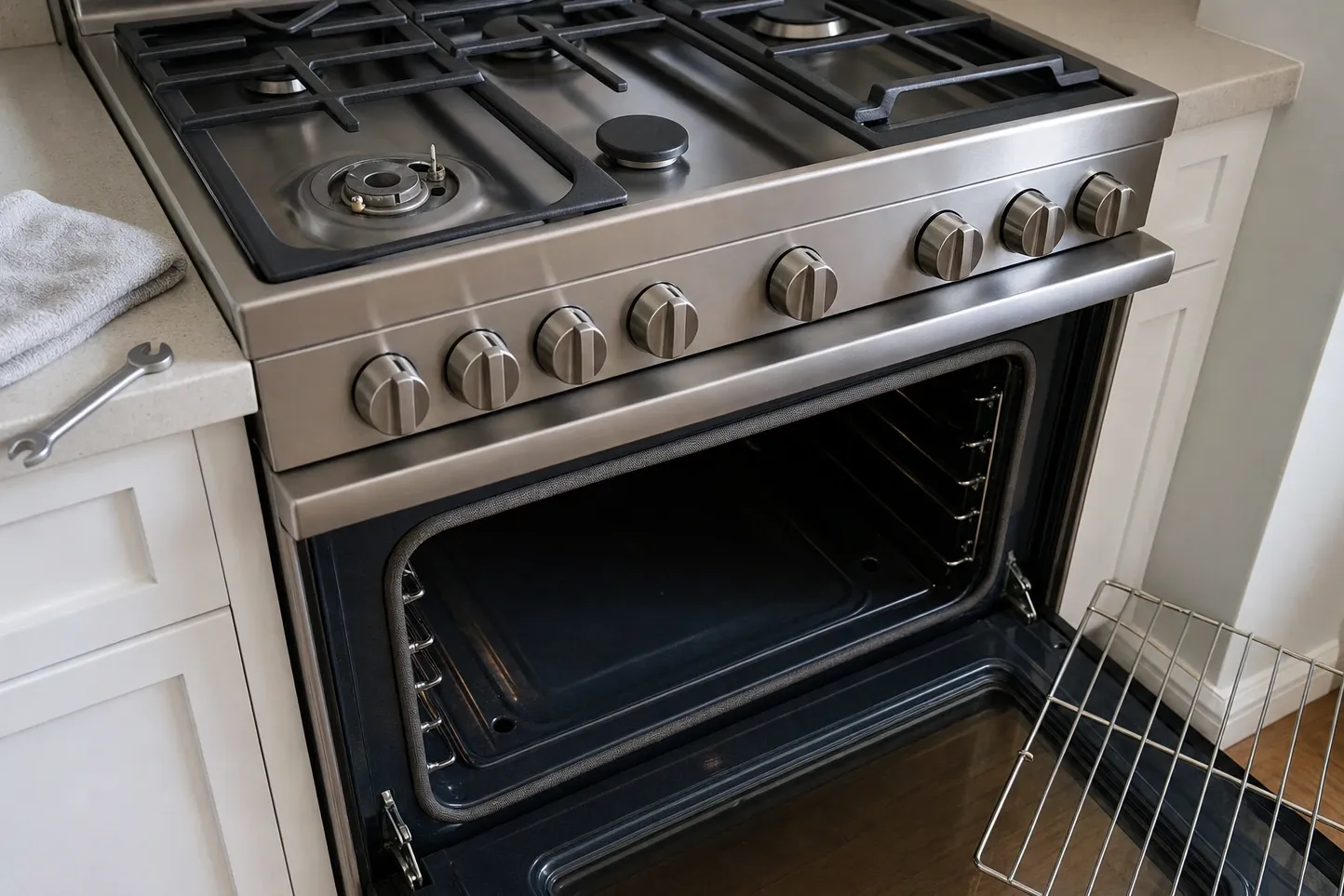
A Viking burner that ticks away and never catches is one of the most common calls on this route, and it frightens people more than almost anything else in the kitchen. The good news is that it is very rarely a gas supply problem, and it is almost never the control board that the internet will tell you to replace. The clicking is the range doing exactly what it was designed to do; something is stopping the last step.
What that ticking noise actually is
Every sealed burner on a Viking professional range has a spark electrode sitting beside it — a thin steel pin in a white ceramic sleeve, angled at the burner head. When you turn a knob past its detent, a spark module starts firing high voltage at that pin, and the spark jumps from the pin to the nearest earthed metal, which is supposed to be the burner head a short gap away. It jumps many times a second, and that is the clicking you hear.
Two details matter for diagnosis. The first is that one module fires every electrode on the range at once, so all four, six or eight burners click when you light any of them. That is normal, and it means the clicking noise tells you nothing about which burner has the fault. The second is that the spark takes the easiest path to earth. If there is an easier route than the gap at the burner head — through a hairline crack in the ceramic, through a film of water on the porcelain, through cooking residue bridging the gap — then the spark goes there instead, and no amount of clicking will light the gas.
The three things that stop the spark
A cracked ceramic insulator. This is the single most common cause, and it usually starts with something falling on the electrode or a pan being dragged across it. The crack is often too fine to see without getting your eye down to the level of the burner. Once the insulator is compromised, the spark leaks to the burner base through the crack rather than crossing the air gap.
Wet or dirty igniters — and two electrical causes nobody expects. Viking’s own troubleshooting chart for its sealed-burner cooktops gives three reasons for igniters that carry on sparking: igniters that are wet or dirty, a power supply that is not grounded, and a power supply whose polarity is reversed. The burners themselves are permanently sealed — the maker’s line is that spills cannot enter the burner box — so this is about what sits on top: water and cooked-on residue around the electrode, giving the spark an easier route to earth than the gas. In Los Feliz and Silver Lake, where kitchens are small and the range gets used hard, a Sunday-morning boil-over showing up as Wednesday-evening clicking is a weekly story. The two supply faults are a wiring question rather than an appliance one, and they are worth ruling out before anybody orders a spark module.
Blocked ports. The burner can be sparking perfectly and still not light if gas is not arriving where the spark is. Fine grit blows down off Griffith Park and into everything with a hole in it, and cooking oil turns that grit into a paste. A burner with half its ports blocked will light slowly, light on one side only, or refuse entirely at the low setting while working at high.
What to check in ten minutes
Do this cold, with the knobs off.
- Lift the grate and the burner cap off the burner that will not light. Look at the electrode from the side, with a torch, at eye level. Any crack, chip or dark carbon track on the white ceramic is your answer.
- Look at the gap between the electrode tip and the burner head. A pin that a pan has bent inward sits too close and will arc straight to the head instead of sparking cleanly across the gas; one bent the other way sparks into nothing.
- Dry the burner base and everything around the electrode. Not a wipe — cap and head off, hot soapy water, dried properly, and an hour with the grates off. If clicking that would not stop now stops, you have found it. Nothing metal on that base: Viking’s guide says a wooden or nylon spatula for anything encrusted, because the base is aluminium.
- Hold the cap up to the light and look through the port ring. Clear anything blocked with a straight pin, which is what the maker’s guide specifies. Never a wooden toothpick: the tip breaks off in the port and makes the problem permanent.
- Reseat the head and cap. Viking is specific about this: the tabs under the head line up with the outside edge of the base, they must not sit over the igniter, and the cap has to finish level. A cap sitting proud on one side is enough to make the flame lift, burn orange or refuse to carry around the ring.
If the burner lights after that, you have fixed it and it cost you nothing but an hour.
When the valve is the problem, not the spark
There is a version of this symptom where the spark is doing its job and the gas is the problem. Before going looking for it, rule out the thing that is not there: a Viking sealed burner has no standing pilot and no knob that has to be held in. The maker’s own guide says every burner is lit by electric ignition, that the control is both a gas valve and an electric switch, and that a burner blown out mid-cook relights itself while gas is still flowing. So there is nothing to hold and nothing to heat up — and no reason ever to put a match anywhere near a burner that has been pushing gas into the room.
What that leaves is the valve stem behind the knob. Old grease dries in it, the stem goes stiff, and a stem that is no longer opening fully gives you a burner sparking perfectly well and still refusing to carry a flame. That is bench work: the stem comes out, gets cleaned and regreased, and goes back. It is not a part that fails so much as one that gets neglected, and it is why a range whose knobs need two hands is telling you something before it fails outright.
Worth calling out for
Ring someone if the clicking will not stop with the knobs off and drying round the burner has not cured it, if the ceramic is cracked, if you can smell gas at any point, or if a knob has gone stiff enough to need two hands. Those are all straightforward jobs with parts that ride on the van — electrodes, spark modules, valve stems — and none of them wants a second visit.
Ring sooner rather than later if the flame is orange and lifting off the cap rather than sitting blue on it. That is combustion going wrong, not just an inconvenience, and it is worth a meter and a proper look at the ports rather than another week of guessing.
Asked after this one
- Should I keep turning the knob while it ticks away?
- Once or twice, briefly. Every attempt puts unburnt gas into the room, so if it has not caught within a few seconds, turn the knob off, open a window and leave it a minute before trying again. If you can smell gas after the knob is closed, stop, ventilate the room and ring for help rather than trying again.
- Why do all the burners click when only one has a problem?
- One spark module fires every electrode at once, so all the burners click when you light any of them — Viking's own guide says to expect that. What is not normal is clicking that carries on after the burner has lit; Viking puts that down to wet or dirty igniters, or to a supply that is not grounded.
- Can I clean the burner ports myself?
- Yes. With the gas off and the parts cold, lift the grate and cap, and clear each port with a straight pin — never a wooden toothpick, which Viking's guide rules out because the tip snaps off inside. Anything that needs a drill bit or a scraper wants a technician, because widening a port changes the flame.