Refrigerator Repair
Viking built-in refrigerator that never stops running
A built-in that runs without ever cycling off is usually losing the argument with airflow, not dying. What constant running means, why a valley heat wave finds this fault first, and what to check before you call anyone out.
Hollis Yamada
- Role
- Service technician — refrigeration and cooking
- In the trade
- 21 years
Splits a call into the sealed system and everything else before opening anything, then works whichever half the symptom really belongs to. The two share a cabinet and almost nothing else.
A Viking built-in is meant to run in cycles. It cools, it satisfies the thermostat, it stops, it sits quiet for a while, then it starts again. When a customer in Studio City or Sherman Oaks rings to say the unit has not gone quiet in three days, the machine is almost never broken in the way they fear. It is losing an argument with airflow, and it is telling you so in the only language it has.
What “never resting” means on a Viking built-in
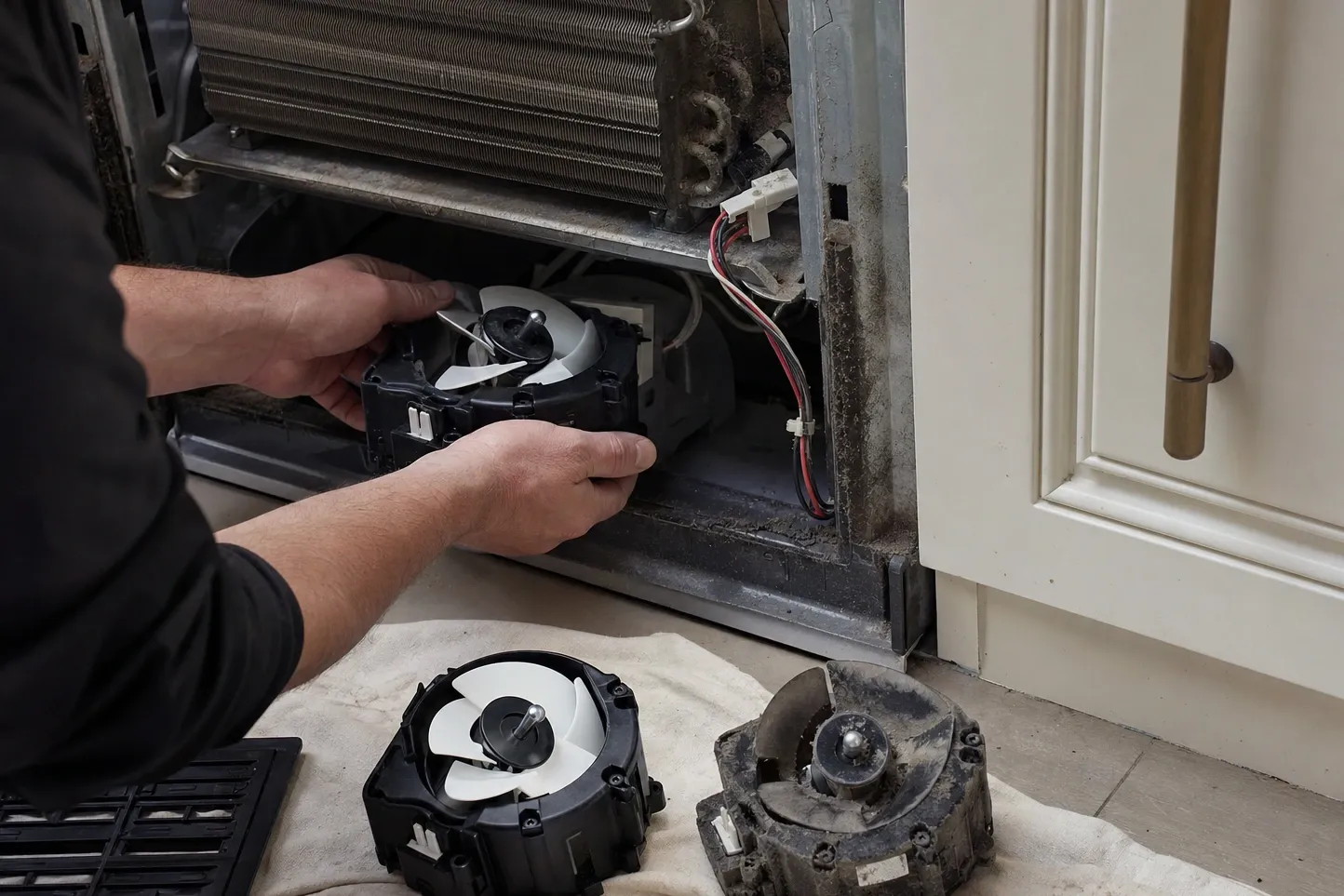
A built-in or undercounter unit has to dump the warmth it pulls out of the food somewhere, and it does that through a condenser coil hidden inside the cabinetry — usually behind the base grille, sometimes at the top of the unit. A fan pulls kitchen air across it and pushes warm air back into the room. The whole design assumes two things: that air can get to the coil, and that the air arriving is cooler than the coil.
Break either assumption and the refrigerant leaving the condenser stays too warm. The machine still cools, but every cycle takes longer, and eventually the thermostat is never satisfied long enough to shut the compressor off. That is constant running: not a failure, but a machine working flat out to stand still. Left alone, the shelves warm up next, because a compressor that never rests also never lets the evaporator defrost properly.
Why a valley heat wave finds this fault first
Over Cahuenga, kitchens sit above ninety inside for days at a stretch in the summer, and a built-in installed in a tight cabinet run has nowhere to put its heat. A condenser furred with a season of dust has been coping quietly all spring at seventy-five degrees ambient. At a hundred and five it stops coping, and the phone rings.
That is why the same fault produces a cluster of calls in the same week and why it is worth looking at the mundane causes first. The three that account for most of it:
- A dust-furred condenser. Grey, matted fins are an insulating blanket over the exact surface that is supposed to be shedding heat.
- A slowing condenser fan. Bearings dry out, the blade turns at half speed, and the airflow that the coil was designed around simply is not there. This one is audible if you know what to listen for: a fan that whirs rather than moves air.
- A door that no longer seals. Every hour a gasket leaks is an hour of warm room air being cooled again, and a hillside house with a sagging door frame is a common culprit. A door that has dropped even slightly stops pulling itself closed at the top.
None of those needs a sealed-system repair. All of them look identical from the outside to a failing compressor, which is why the reflex quote of “you need a new refrigerator” gets so much use and is so often wrong.
What to check before anyone comes out
- Pull the base grille off and look at the condenser fins with a torch. If they are grey and matted rather than metal-coloured, vacuum them gently with a soft brush attachment, working with the fins rather than across them. Do not use a screwdriver or anything stiff — a bent fin is worse than a dusty one.
- Put your hand near the grille while the machine is running. You should feel warm air being pushed out steadily. Nothing moving, or a barely detectable drift, points at the fan rather than the coil.
- Shut the door onto a strip of paper and tug it free. Try that at four or five spots down the run and along the top edge. Anywhere it slides out with no drag is a leaking gasket, and the top corner opposite the hinge is where a dropped door shows up first.
- Stand a thermometer in a glass of water, leave the glass on the middle shelf for four hours, and only then read it. Water holds the temperature the food is actually living at, which is not always the number the display is reporting. Under 38°F is fine; steadily over 42°F means the food load is at risk.
- Check whether there is anything new next to the unit throwing heat at it — a range pushed closer during a remodel, a wine cooler squeezed into the same run, a dishwasher venting into the same plenum. In Sherman Oaks remodels, sharing one cabinet space between a professional range and a built-in is common, and it is a real cause and not a technicality.
If the coil was filthy and the machine starts cycling again within a day of being cleaned, that was the whole fault.
When it is the sealed system and not the airflow
There are patterns that airflow does not explain, and they are worth naming so nobody spends a weekend vacuuming a coil that was never the problem.
If the compressor runs constantly but the cabinet is barely cool at all — not drifting warm, genuinely not cold — and the condenser is clean and the fan is moving air, then the machine is circulating refrigerant that cannot carry heat. A partial restriction or a low charge behaves exactly like that. Frost patterns help: a thin band of frost near one end of the evaporator with bare coil beyond it is a classic low-charge picture.
If the freezer holds solid while only the fresh food side drifts warm, that is not the compressor either. That is air distribution — an evaporator fan, a blocked duct, or a defrost fault icing the coil that feeds the fresh food side. It is a different repair from the same symptom, and telling the two apart is a five-minute job with the right meter and impossible from a phone description.
Worth calling out for
Ring someone if the fresh food side is above 42°F, if the fan is not moving air, if you can see frost building anywhere it should not be, or if the machine has been running without a break for more than a couple of days after the condenser has been cleaned. Condenser fans, evaporator fans, door switches, gaskets and thermistors travel on the van; anything in the sealed system is ordered against the model and serial on the rating plate, so read those out when you ring and the second visit usually is not needed.
Asked after this one
- Is a refrigerator that runs constantly using much more power?
- Yes, and that is the mild part of the problem. A compressor that never cycles off is running at its duty limit for hours at a time in a hot cabinet space, which shortens its life. The food temperatures usually drift up before anything fails outright, so constant running is a warning worth acting on rather than tolerating.
- How often should the condenser be cleaned?
- Once a year is enough for most kitchens. Make it twice if there is a dog in the house, if the kitchen carpet or rug sheds, or if the unit sits close to a range that throws heat at it. It is a base-grille job with a vacuum and a soft brush, not a service call.
- How warm is too warm inside?
- The fresh food side wants to sit at or just under 38°F and the freezer near 0°F. A fresh food compartment holding steadily above 42°F is where a food load starts being at real risk, and at that point the reason the machine is running constantly matters much less than getting someone to look at it.